Author: admin

  • YOGA AND THE WISDOM AGE

    YOGA AND THE WISDOM AGE

    So it’s tricky this yoga practice of ours, and it’s complicated, taking a practice that began on a mat and now, as time passes, needing to change the emphasis from mat, to mind and attitude

    With age you gain wisdom but there’s a loss too. The loss of flexibility, the loss of potential, the Yoga Sutras tell us that everything changes and that’s true, an inevitability.

    But how do we cope with the experience of our yoga spreading outwards off the mat and moving into guiding our lives. Well most of it is amazingly wonderful, our understanding of relationships, the way we know how we have the freedom to deal with each situation that arises in a different way than we used to.

    The wisdom is joyful, but as yoga becomes known only as a mat based form of exercise, we struggle a little, there’s a bit of frustration, a bit of anger, still to be dealt with. Our cry of “this is not yoga” can go unheard, it’s almost a whisper.

    Unless we stop calling mat based exercise classes yoga, and start calling them asana, we are going to lose touch with the practice of yoga in all its eight limbed glory.

    And those that have reached the wisdom age, that have always practiced, that are now letting go of their mat based practice, will be made to feel that they no longer do yoga.

    A little maintenance for the body is enough, our place in yoga changes, we work on good relationships, good attitudes, we work on contentment, we work on community.

    Our yoga works outwards from the mat to all that surrounds us.

    The Yoga for Health and Education Trust is here to support you, for those in their wisdom age, and for those who have not felt included in the rise of body focused yoga and wish to gain a supportive sangha that will help you move forward from mat to life skills and yoga community.

    So from those of us that have reached our wisdom age, that are moving our practice forward, come and explore with us, there is so much more to practicing yoga than you could ever imagine.

    Gill Ansty
  • THE THEME OF CHARNEY MANOR RETREAT IN MAY, SANTOSA, CONTENTMENT, YOGA SUTRA CHAPTER 2. VERSE 29

    THE THEME OF CHARNEY MANOR RETREAT IN MAY, SANTOSA, CONTENTMENT, YOGA SUTRA CHAPTER 2. VERSE 29

    So the big question, is it possible for us to ever be content?

    Interesting to think about, to just for a moment, take the time to consider, and then ask yourself the question, am I ever content?

    We have restless minds, we know that, in our minds, contentment seems to be more of an aim than a reality. A thing to aspire for, in the future, a maybe, a someday, if I can just get this last thing, then contentment will come.
    The Yoga Sutras tell us that Santosa, contentment is one of the observances, the disciplines, we need to be practising now, right now, in this present moment as part of our yoga.
    As important as asana, as important as all the other limbs in our eight limbed practise.

    But we have so many distractions, so many needs, so much moving forward to do in our lives, how can we even be aware of contentment, how does it enter, how does it stay, how do we recognise it when it is here.
    There’s a wonderful Sanskrit word, and the word is viveka, it means discerning, to be able to tell the difference between one thing and another, to discriminate.

    So that then, you know which one is the inhale and which the exhale, the right arm and the left, the sun and the moon, to know the difference between one thing and another, and to have space between them, and ultimately, of course, to know the difference between purusa and prakrti.
    So when looking for contentment, you can use viveka to notice your feeling of discontent( we all recognise this) that feeling of needing something more, the I wants of life,
    and you can use viveka to help you to notice the things that you feel content with, to notice this opposite, notice its quality, observe how it feels.

    And you can discover that we do have moments in which we are content, we sometimes don’t notice them and they can be lost in our constant activity, but every now and then, we hear the bird that’s singing nearby, we watch the butterfly as it passes, we smile at a friend, and sometimes we value the quiet and the stillness, and we just stay in it.
    Santosa, contentment, yes, we all recognise this, we will be sharing a moment of contentment, recognising it and acknowledging it at Charney Manor in May, looking forward to meeting you all there.

    Link for Charney Manor event

  • LETS PRETEND

    LETS PRETEND

    It’s easy to think that the yoga sutras aren’t relevant to us now in our life and let go of any interest in such ancient texts, and we can ignore the wisdom held within them, which is there to help us improve our lives, we can ignore them or we can have a look and see if we recognise anything that may be helpful to us.

    In my exploration I’ve been constantly shocked at how relevant they are, I’ve discovered that they are the best therapy, recognising myself, and the way my mind acts up in moments of stress has been life changing, and in them I’ve found practical ways of coping that would have helped my mental health better than any other, if only I had found them sooner.

    It’s strange to think you can have a favourite yoga sutra. 

    A best friend that’s always helpful. 

    Prati paska bhavanam-When harassed by doubt cultivate the opposite.

    But for me it’s Chapter 2 verse 33. 

    Sounds like nothing, but taking that first step towards practising it is at first, like all practises, quite hard. That first toe in the water that requires you to alter your normal reactive behaviour, is tricky! Old habits die hard.

    So my way to begin, is to pretend.

    Let me pretend the thing I don’t want to do, is the thing I really do want to do.

    Let me pretend the person I have difficulty with, is a person whose company I love.

    Let me pretend the thing that scares me, I am fearless within.

    Chapter 2 verse 33

    When harassed by doubts cultivate the opposite, 

    Placed there in the yoga sutras to support the nyama, it seems small but it’s mighty.

    My recommendation to you would be play pretend with it, it will surprise, delight and change your interaction with the world.

  • THE INHALE 

    THE INHALE 

    AN ASTHMATICS JOURNEY FROM DENIAL TO ACCEPTANCE.

    ( but please don’t light that incense, even though I don’t have asthma!)

    Very recently I went to a spa day, a treat for my birthday, hot pools, rooms to sit in, and essential oils, all the best stuff.

    In the few days afterwards my air way slowly inflamed, and I am now on a course of steroids, to make me able to breathe again.

    My fault I should have known!

    But it got me thinking.

    I was diagnosed with seasonal asthma a good few years ago now, it could be the weather, mushroom spores, change of weather, could be anything, and I was given a blue inhaler/ reliever. 4 x a day when needed.

    At this point I can honestly say my reaction was, yes I will do that! , but I don’t have asthma, I’m 60, I’ve never had asthma!. It’s a blip. And I became in denial of my asthma. And continued to be so for a long time.

    Then Covid kicked in, and before we went into lockdown , when everybody started cleaning things, I locked down early because my asthma had become uncontrollable ( I was put on a daily combination inhaler and have been on it ever since).

    My new inhaler fixed it.

    Denial stopped, I do have asthma.

    But what triggered it was still unknown.

    Then a flight, and a walk through duty free, as an enthusiastic sales girl sprayed perfume at me, and I had my first big reaction, no breath, no speech, get the inhalers out

     Very scary!

    It’s led to me avoiding these situations,

    So yes! Spa trip. My fault!

    However, it made me think how impossible life is becoming, as the world is consistently being perfumed, plug ins, washing powder, every where insisting that somehow, the world can smell sweeter, better, cleaner, purer.

    And that saying I have asthma can give you the impression that there is something wrong with me, in my being, and that I’m allergic to something that I shouldn’t be, that I am somehow weaker than others.

    But I say, pollution comes in many forms.

    It took till I was 60 to affect me, but pollution has become greater than when I was young.

    Perfumes are as much responsible for our pollution as many other things.

    Our children are being born into this.

    So before you perfume your house with the smell of rain, why not wait till it does rain and go outside.

    Why not wait till you’re at the ocean to smell the ozone.

    Why not leave your bedding with the smell of clean, rather than jasmine.

    If something’s dirty I want to smell that, if foods been cooked I want to smell that.

    Don’t force me to smell something different.

    And don’t take it into pharmacy’s, and shops and venues and don’t light that incense indoors.

    Because my world is shrinking, and so is yours.

    Gill Ansty YHET trustee

    Yoga therapist.

  • HOW COMFORTABLE DOES MY YOGA PRACTISE FEEL?

    HOW COMFORTABLE DOES MY YOGA PRACTISE FEEL?

    The yoga sutras tell us that our practise of yoga should always have within it Sthira and Sukha, stability and ease and comfort. 

    Yoga sutra chapter 2 verse 46.

    Sthira the stability 

    Sukha ease and comfort.

    That our practise isn’t yoga without these qualities, and I’ve been pondering on these ideas and acknowledging that this isn’t as easy as it sounds.!

    Is it really comfortable?……….

    Like all things in yoga, we can hear the teaching but that is as far as it goes, but we don’t always digest it, absorb it and eventually embody it.

    Well I know, from my own experience, and I am aware it may not be the same as yours, that I’ve found myself sometimes pushing through in asana , trying too hard, desperately trying to improve that posture, to get to that perfect picture that I have put in front of me, because I want to do it better! 

    Sukha- (ease and comfort,)  straight out of the window!, I just need to get my nose on my knees!!
    but in fact the kha part of  the word sukha translates to the heart space , so sukha in fact means ease and comfort in the heart, in the same way dukha means suffering in the heartspace. 

    So it’s not the body we are talking about, but how we feel.! 

    Is our practise containing enough sukha in it to feel good, heart, mind and body.?

    Clearly pushing my body to get my nose on my knees, when it just won’t go there, creates suffering, and deciding it should go there and that it is important that it does go there, creates more.

    So in fact trying too hard has the opposite effect to the one we are trying to find.

    So let’s bring our attention to the other part of this sutra, sthira (stability) in the sutra it comes first before sukha, and I would suggest there’s a reason for that.

    Because sukha can only exist if sthira is there, ease and comfort evolves from stability, we need them to work together. sukha without sthira has no support, sthira without sukha is too rigid.

    So place your support well and ease and comfort will grow from It as do all things in life, not just those on the mat.

    But to do that first we also have to acknowledge satya (truthfulness) we have to be truthful with our selves, exploring a posture or any situation we find ourselves in, with satya in mind, modifying, adapting and creating an environment in which our stability is good and our ease and comfort can grow, is the best practise.

    So if, like me, you occasionally find yourself trying too hard, and aspiring to someone else’s idea of perfection. 

    Forget it, you need your stability placed well, you need to feel ease and comfort in your heart space and if both of these things are there, you are practising yoga

    If however you’re struggling, pushing, trying too hard, then you are not.

    So I feel that this lets me off the hook, my ponderings have taken me to a place where I will no longer continue to fight with my nose and my knees, and I will rest with my sthira supporting me and my heart happy

    Yoga Sutra chapter 2. Verse 46

    Sthira suksham asanam – stability, steadiness, ease and comfort

    Yoga Sutra chapter 2. Verse 36

    Satya Referenced from https:/yogainternational.com

    (Truthfulness), the second of the 5 yamas ( restraints) described in the yoga sutras, guides us to think, speak and act with integrity.

    The word sat means ”that which exists,that which is” Satya therefore is seeing and communicating things as they actually are,not as we wish them to be.

    Gill Ansty YHET Trustee

  • THANK YOU JOHN ROEDEL AND YOGA.

    THANK YOU JOHN ROEDEL AND YOGA.

    I recently discovered a poet called John Roedel,

    Others I knew had heard of him, but for me he’s been a revelation.

    From Peace is a Lioness, to my Head and my Heart divorced, I have become addicted.

    And I began to think and to wonder, if he would have appealed to me as much when I was younger.

    That love for different poets changes, as do the moments in which we read them.

    In the right place at the right time and something resonates, it could be with your experience from the past or the present, or it could just be a light bulb moment, lit by the words themselves.

    But I know for me, it’s when I find the yoga in them.

    When something that’s said reveals an ancient yoga teaching in a modern way.

    Nothing to do with the physical practise, but that affirmation of the understanding that yoga has of the way the world is, the acknowledgement of it and the way to live in it with peace.

    We follow a practise that gives us the tools to live our lives in the best way we can.

    The eight limbs give us a way to behave that allow us to like ourselves, to be healthy and mindful and considerate of others. 

    Our teachings are passed on by gurus, teachers and students, from one to another. And we hold them as our practise.

    And then along comes John Roedel and out of him spills our teachings in a messy, modern, human and glorious way. 

    So look up the poem Hope by John Roedel it’s in his book Wonderache, then continue exploring he’s got a lot to say, and look at My Head and My Heart divorced, which is in his book Remedy, there is yoga there and not a mat in sight.!

    Gill Ansty YHET trustee

  • THOUGHTS ON YOGA.

    THOUGHTS ON YOGA.

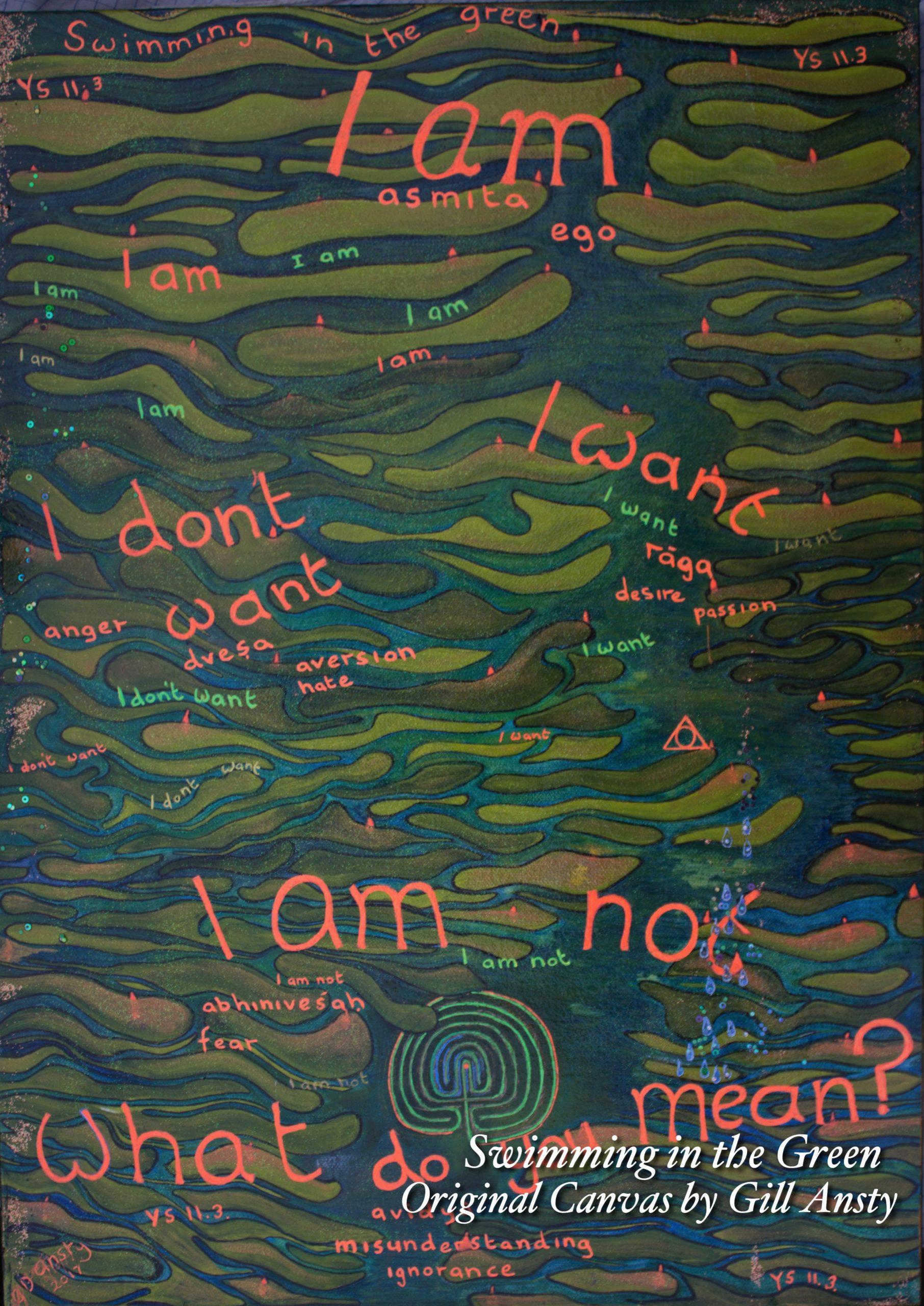
    WATER AND THE EXPERIENCE OF THE KLESA ABHINEVESAH- THE FEAR OF DEATH.

    The external.

    Externally it’s been a strange week of water, stuck in Valencia with the Dana.(the storm)

    A fear of the repetition of last years’ event, everyone nervous.

    This life giving necessity, that we all need so much, suddenly becomes a force to be reckoned with.

    The pleasure we have taken in swimming in it, now changes to us running away.

    Watching the gullies, and  the dry river beds for the return of the horror of last year.

    Should we go out, should we stay in? Is it safe now or isn’t it.?

    Fear takes over our thought patterns, it’s pushed at us from past experience, past knowledge, it’s there to keep us safe but is it needed right now or is it just causing more fear.?

    The Klesa rises

    Water

    The Internal

    Svadisthana cakra

    Internally we know our connection to it, we know about our emotions, our moon connection, we know about our fluidity. We know about our need to flow with it.

    We talk about finding other paths around obstacles by using the ability of water to go round them and not force our way through.

    And yet, fear can take over, can flood every sensation in the body so our clarity is gone and the full force of water floods us and we have no resistance. Emotions overwhelming

    Once again fear takes over our thought patterns, it’s pushed at us from past experience, past knowledge, it’s there to keep us safe, but is it needed right now or is it just causing more fear.?

    The Klesas – afflictions

    5 seeds that are the root causes of suffering in yogic philosophy

    Avidya- misunderstanding or ignorance

    Asmita- ego

    Raga-attachment

    Dvesa-aversion

    Abhinivesah-fear of death

    The klesas are said to be seeds within us, just seeds, but when we water them they can be fully grown trees within seconds.

    This is the power of water.!

    The practise of pranayama cuts the growth.

    Remember to breathe………………………………

    Gill Ansty YHET Trustee

  • THOUGHTS ON YOGA – LET’S TALK ABOUT ATTACHMENT.

    THOUGHTS ON YOGA – LET’S TALK ABOUT ATTACHMENT.

    OR NON- ATTACHMENT- APARIGRAHA THE 5TH YAMA

    Discuss………….

    So many interpretations of what this means.

    Many think it’s about letting go and of course it is, but it runs deeper and deeper to not attaching ourselves in the first place, until letting go is not needed.

    But do we really know what we are attached to, do we have a clear view of it.

    I thought I’d make a list and this is the direction it took me in.

    1. Stuff, oh yes! I’m very attached to stuff, collecting it, wearing it, dusting it, buying more, yes stuff is definitely on my list.
    2. But I have lived without stuff and existed well…………
    3. Then there’s my opinions, I’m definitely attached to my opinions, but my opinions change and are sometimes wrong. In fact give me yours and I may adopt them and leave mine behind, and then what was absolute truth last week can be completely false this week, so my opinions change and you can’t trust them, nor can I……….
    4. Mistakes, of course I make mistakes, but these are harder to acknowledge than too much stuff, and letting go of my insistence on being right, no matter what, that’s harder to let go of than a treasured piece of clothing or an ornament……….
    5. Negative thoughts, we all suffer from them, what trapped us in them anyway, where did that come from, that lack of self belief that lies us low sometimes, and talks us down, how attached are we to those, because we keep going back……..
    6. It’s not just beauty and treasures we become attached to, it can be ugliness and sadness too, we attach ourselves to the familiar good or bad……..
    7. In fact we can become so attached to the feelings we have always felt, that we forget that we no longer have any need of them. What once was supportive becomes a trap………..
    8. And then there is guilt, that if only! …..I should have done it differently!…..I could have but!……..kind of guilt, where, after fixing the problem, we forget to forgive ourselves.

    We forget to forgive ourselves for being young, for not knowing any better, for making mistakes.

    There are many forms of attachment, and yes letting go is a good idea, and we must practise that, until not attaching yourself in the first place becomes a better choice.

    And as a very wise Buddhist monk once said, whilst taking a sip from his favourite cup, we must remember….

    “The cups already broken”……..

    Gill Ansty YHET Trustee.